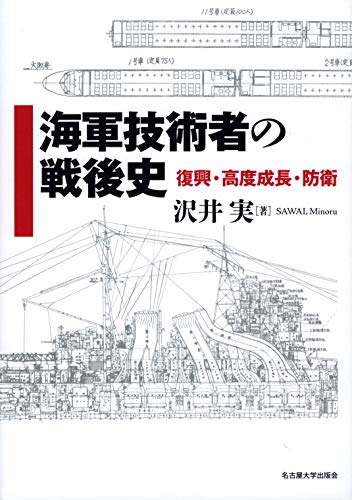
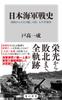
What role did naval engineers play in Japan's postwar reconstruction and development? This book reconstructs the overall picture of the technological transfer that underpinned Japan's rapid economic growth in areas such as shipbuilding, automobiles, Shinkansen development, and civil engineering. It objectively describes the qualitative and quantitative impact of this transfer, including defense production, and highlights the historical nature of the engineers' experience of defeat.
[Book Review]
- Social and Economic History (Vol. 87, No. 3, November 2021, Reviewer: Shingo Nakajima)
"... This book is significant in that it focuses on the Imperial Japanese Navy's role as an elite technical group, and delves deeply into its diverse postwar historical footprint, both individually and empirically. Although the term "naval engineers" is often broadly used, in reality they are diverse, and after the war, when the Navy, the parent organization, disappeared, their activities spread to a wide range of fields, including national institutions, academia, and private companies. This book carefully portrays this diversity, but in addition to focusing on individuals, it does not neglect what becomes apparent when the whole picture is taken. What makes this even more persuasive is the huge number of people involved. It contains appendices and lists of personnel, covering the number of personnel, and presents their deployments, positions, ranks, and postwar careers in the Imperial Japanese Navy. This work also makes it possible to grasp the direction and characteristics of the group, which cannot be grasped by simply tracing the careers of each individual. …” (p. 86)
- Economic History Research (Issue 24, January 2021, Reviewer: Satoshi Kobori)
- Business History (Vol. 55, Issue 3, December 2020, Reviewer: Kenichi Arakawa)
- Historia (June 2020, Reviewer: Tomoaki Murakami)
“… The greatest significance of this book lies in its comprehensive, richly nuanced portrayal of former naval engineers' postwar careers, based on as much research as possible. As the author points out, the conventional wisdom has been a simple success story: "Just as water flows from high to low, talented demobilized military engineers entered the private sector, resulting in significant advances in technology" (p. 240). However, the author, who is uneasy with this conventional wisdom, brilliantly reveals in this book that the reemployment destinations of naval engineers varied considerably depending on their function and rank (shipbuilding, machinery, facilities, and engineering officers), and that their paths were not always straightforward. The highlight of this book is the extensive list of careers of former naval engineers compiled by the author from various sources in each chapter. A look at each of these varied reemployment destinations is endlessly fascinating. Meanwhile, the author carefully introduces the personalities and career histories of each representative naval engineer, revealing the considerable range of career paths available to them, even within each professional group. Among these figures is a surprising one, such as Nagayoshi Matsudaira (45th class of the Naval Engineering School), who, as the chief priest of Yasukuni Shrine, carried out the enshrinement of Class A war criminals. The book's appeal lies in the fact that, given the wide range of individuals covered, each episode contains valuable information that will appeal to researchers in a variety of fields. ..." (p. 91)
- Rekishi Hyoron (July 2020 issue, No. 843, Reviewer: Isamu Hatano)
"... No one who picks up this book and flips through its pages will be stunned by the vast scope of the research and the magnitude of its results, which are culminated in numerous detailed and extensive tables. And there is probably no researcher in this field who would not be delighted to enjoy its results. I would like to express my respect for the breadth and depth of the author's scholarship, which has systematically compiled the movements of almost all of the key figures, if not all, of the more than 10,000 individuals. However, the book's value lies elsewhere. As I continued to read through the text and trace its sources, I was struck by the book's precise selection of representative figures in each chapter, and the sources used in their explanations (in terms of reliability and historical value) are of a quality that could not be better expected. ..." (p. 94)
- Nihon Rekishi (Japanese History) (April 2020 issue, No. 863, Reviewer: Jun Suzuki)
"The contributions of former naval engineers to postwar technological development and economic growth are widely known through nonfiction works. However, in this book, the author, who has a long history of work on the history of the machinery industry, industrial education, and technological development systems, traces their personal histories and delves into the consciousness of the people involved, describing their roles and lives during the military-civilian transition and the emergence of "defense production." ... The author's approach, which goes beyond reporting on the "achievements" for which documents remain and are readily accepted by the general public, to understanding the "continuities and discontinuities" between the wartime and postwar periods, while also paying attention to the "countless engineers who do not appear in historical documents" who did not respond to calls from organizations related to the former navy, is deeply instructive. (pp. 99, 101)
- Weekly Dokushojin (June 14, 2019, Issue 3293, Reviewer: Toru Takeda)
- World's Ships (June 2019, Issue 901)
"... The book clearly summarizes the work of shipbuilding engineers involved in the construction of merchant ships and Self-Defense Forces ships, machinery engineers who contributed to the development of vehicles and industrial machinery, and facilities engineers who worked for construction companies to rebuild the country. It also does not overlook the activities of engineering groups that made recommendations on defense policy. This is a valuable book that offers an easy-to-understand look at the achievements of naval engineers, both famous and unknown, who quietly supported Japan's postwar history. " (p. 113)
- JShips (June 2019 issue, Vol. 86)
"... Through their statements and views on technology, this book reveals the aspirations of naval engineers as they navigated the postwar era and survived the prewar, wartime, and postwar periods. Its objective analysis, which sometimes points out problems, offers a comprehensive picture of the technological transfer that supported Japan's rapid economic growth, including shipbuilding, automobiles, Shinkansen development, and civil engineering, as well as the impact of defense production. " (p.105)
[Table of Contents]
Preface: Who Are Naval Engineers?
Chapter 1: Towards Carrying on the Shipbuilding Empire
— The Postwar Life of a Former Naval Shipbuilding Engineer
Introduction
1. Role as a Technical Advisor in Japan's Postwar Shipbuilding Industry
2. Various Initiatives in the Private Sector
3. Activities at a Private Shipyard
4. The Postwar Life of a Shipbuilding Officer—The Case of Ichiro Onozuka
5. Role in Shipbuilding
Conclusion
Appendix: Materials on the Postwar Careers of Former Naval Shipbuilding Engineers
Chapter 2: Moving to Transportation Machinery, Industrial Machinery, and Electrical Machinery
— The Postwar Life of a Former Naval Technical Officer (Machinery Engineering)
Introduction
1. Composition and Education of Machinery Engineering Engineers
2. Private Companies and National Institutions Employing Three or More Former Technical Officers (Machinery Engineering)
3. Individual Company Cases
4. Japan National Railways/Railway Technical Research Institute and the Defense Agency/SDF
5. Naval Experience and Postwar Research Activities
Conclusion: Technological Development and Collaborative Research
Chapter 3: The Origins of a Civil Engineering Nation
— Former Naval Facilities Engineers After the War
Introduction
1. The Role of the Ministry of Transport's Transport and Construction Headquarters
2. Former Naval Facilities Engineers After the War
3. Activities and Statements of Former Naval Facilities Engineers
Conclusion: The Conversion of Military to Civilian Affairs as a Group
Chapter 4: The Wanderings of Naval Officers
— Naval Engineering School Graduates After the War
Introduction
1. Naval Engineering School Education, Graduate Careers, and Study Abroad
2. Naval Engineering School Graduates After the War
Conclusion
Chapter 5: Regrets and Awareness of Elite Engineers
— JNR Transferred and Repatriated Engineers After the War
Introduction
1. Postwar History of Japanese National Railway Engineers
2. Postwar History of Japan Institution of Professional Engineers (JIP) Member Engineers
Conclusion: Sharing Technological Nationalism
Chapter 6: Postwar Developments in Defense Policy
— Establishment of the Naval and Air Technical Council and Its Activities
Introduction
1. Cooperation between the Naval and Air Technical Council and the Japan Business Federation's Defense Production Committee
2. The Activities of Zenshiro Hoshina
3. Activities of the Naval and Air Technical (Council) Research Office and the Naval and Air Technical Research Committee
4. Composition of the Naval and Air Technical Council Members
Conclusion
Final Chapter: Historical Characteristics of the Military-Civilian Conversion
Notes / Afterword / List of Figures and Tables / Index


 No-delivery refund


![Motorcycle Model Making Strategy Method 2024 July 2024 Issue [Magazine]: Model Art Special Edition](https://img.joomcdn.net/826b0f4e0c3ca590c0e25e38672606efe3dd2486_76_100.jpeg)






![[Large Print Book] Selected Short Works of Osamu Dazai (Volume 1) (Kyorinsha Large Print Book Series)](https://img.joomcdn.net/d16cfbc2d7741a9b9fecf6497623cb1d17c1a3e6_70_100.jpeg)