Worth knowing:
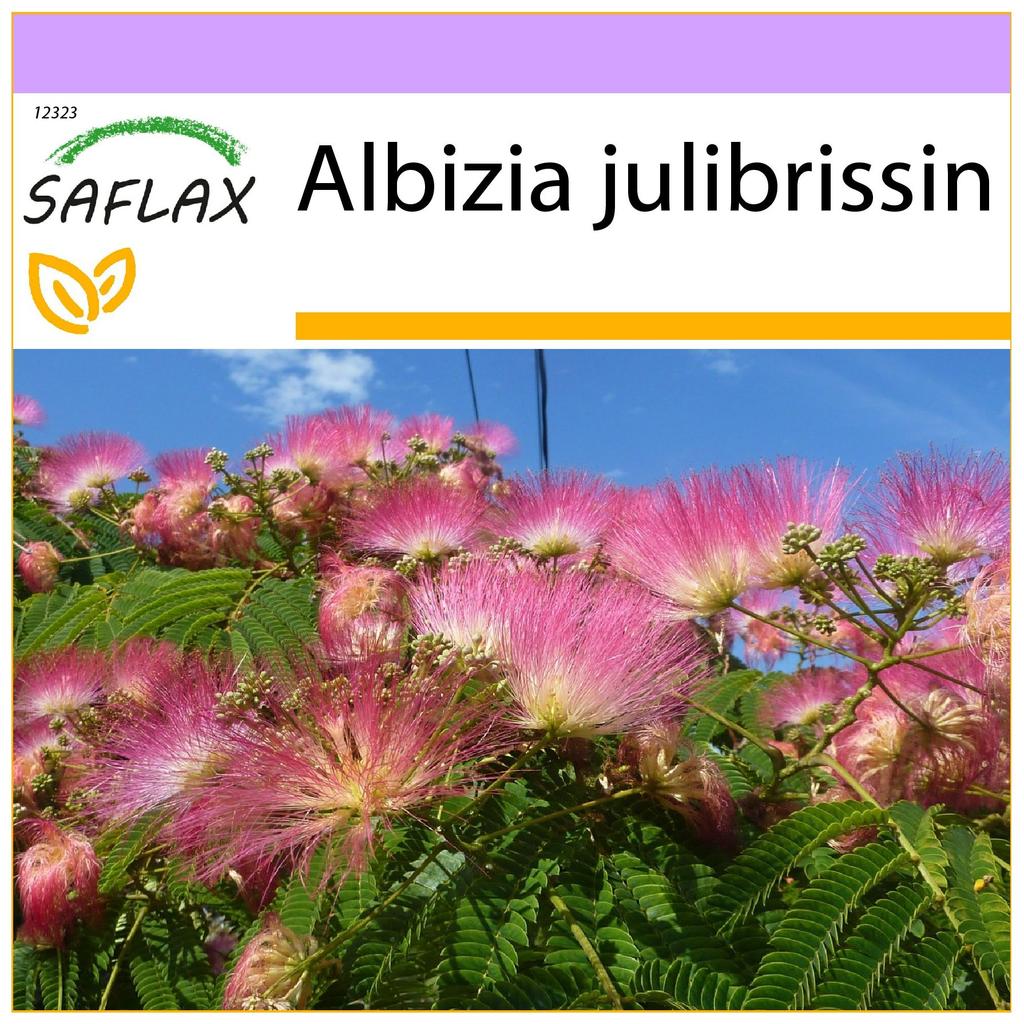
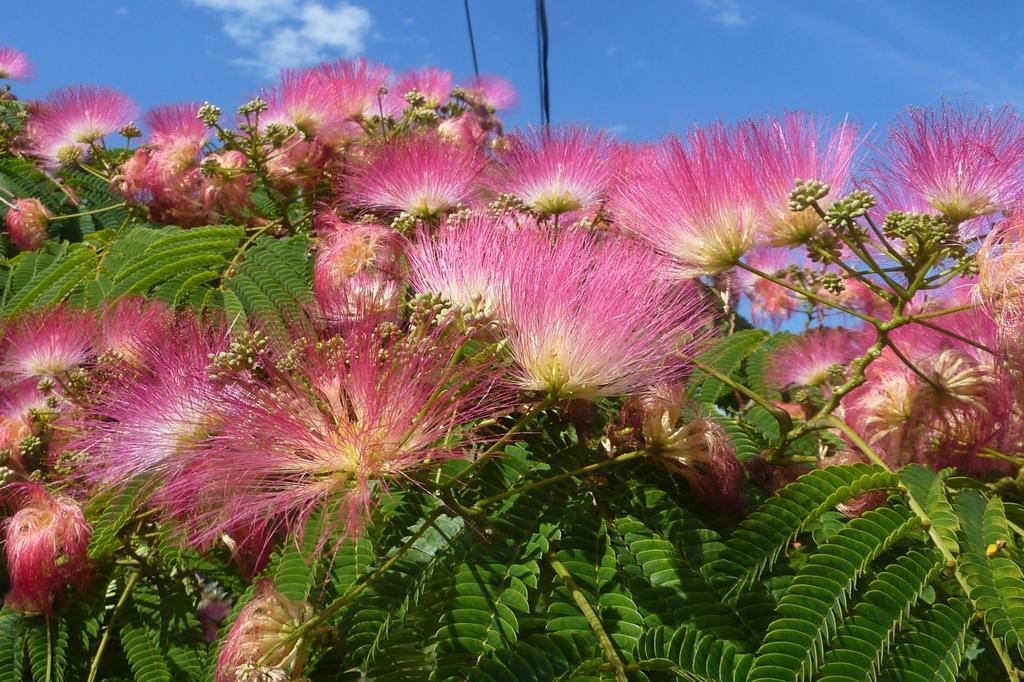
The fast-growing Pinc Acacia can easily be kept in a tub or outdoors in your garden. Its delicate and double pinnate leaves don’t collapse, like the Mimosa, when touched, but they fold in at night and in case of dryness. During summer it displays an umbrella-like crown with many light pink and slightly aromatic powder puff blossoms on its upper sprouts.
Natural Location:
Its natural habitat extends from Iran to the Himalayan and Central China until Japan. Nowadays it can be found in nearly all tropic and subtropic areas.
Cultivation:
Seed propagation indoors is possible throughout the year. To increase the germinability, you should place the seeds overnight in warm water for priming. Then plant the seeds about 1 cm deep in moist potting compost and cover the seed container with clear film to prevent the earth from drying out. Don’t forget to make some holes in the clear film and take it every second or third day completely off for about 2 hours. That way you avoid mold formation on your potting compost. Place the seed container somewhere bright and warm with a temperature between 20°C and 25° Celsius and keep the earth moist but not wet. The first seedlings should already come up after two to three weeks.
Place:
The Pinc Acacia likes a warm and half-shaded or sunny place. At best, you can keep it savely near a wall to the southside.
Care:
The Pinc Acacia is quite carefree, but it needs a bigger pot or tub right from the beginning, to grow strongly and bring out a rich blossoming. If you want a bit more bushy growth you can prune the plant more often, but even without pruning it builds up a nice umbrella-like crown. During summer it is recommended to water the plant regularly, but avoid water logging , for instance in the saucer. If it is too hot and dry, it will fold in its leaves even during the day and react later by casting off leaves. Between spring and autumn you should give fertilizer for tub plants every two weeks, to enrich blossoming.
During the winter:
Tub plants are best kept in a bright spot with a temperature between 5° and 15° Celsius during hibernation. Give water only sparingly. For outdoor plants it is recommended to frost-protect your tree in its first couple of years, by putting leaves around the root area and some fleece lining or coconut matting around the stem. When it gets older, the tree will become more frost-resistant and by experience can handle temperatures up to -15° Celsius.
Picture credits:
- © © Erdrokan - CC-BY-SA-3.0 - http://creativecommons.org/licenses/by-sa/3.0
- © Frank Laue - © Saflax - http://www.saflax.de/copyright
- © Frank Laue - © Saflax - http://www.saflax.de/copyright
- © Erdrokan - CC-BY-SA-3.0 - http://creativecommons.org/licenses/by-sa/3.0
- © - -
- © - -
- © - -
- © - -
- © - -




 No-delivery refund