Worth knowing:
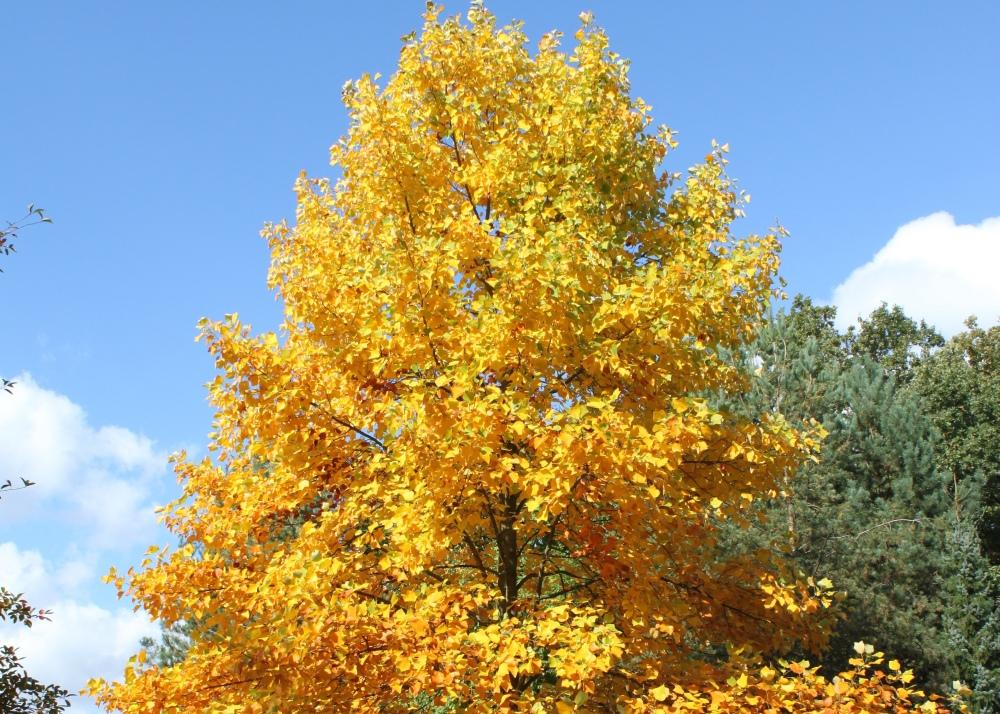
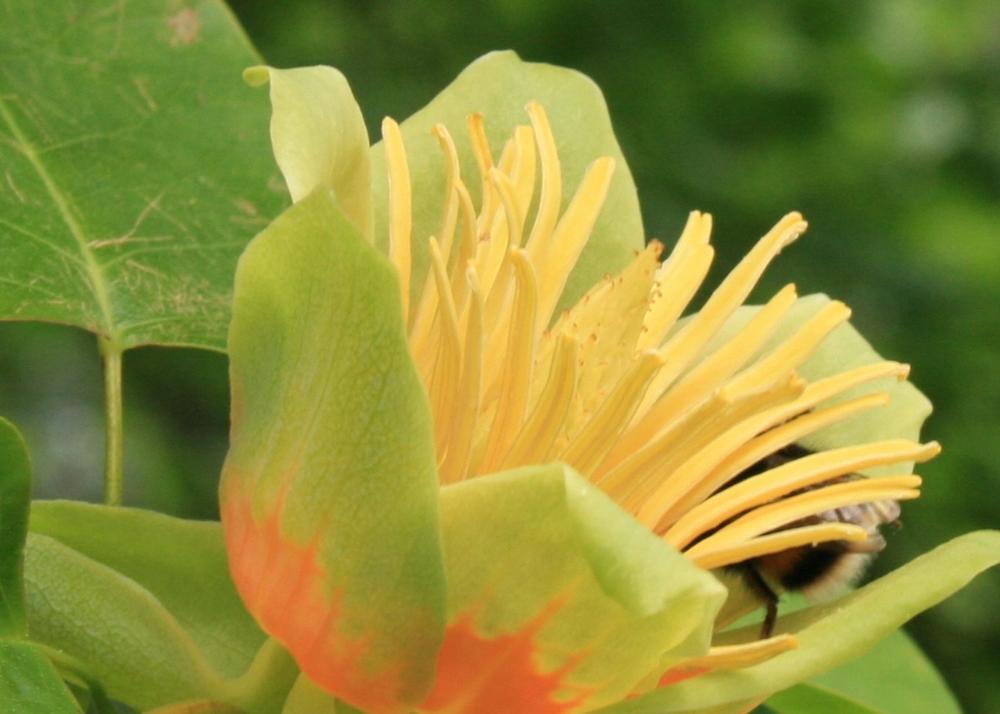
The Tulip Tree is found mainly in North America and counts as one of the at least 100 million years old species of the magnolia family - it is therefore one of the oldest known and still existing flowering plants. Its summer-green leaves have a characteristic irregular, four-lobed and at its ends callous form. The cup-shaped, green-yellow flowers with orange-coloured spots resemble tulip or magnolia flowers with an average size of 10 cm. During autumn the foliage of the Liriodendron tulipifera takes on a blazing golden-yellow colouring. The initially dense and compact conical crown of the tree becomes later more roundish and expanding. Over the years the Tulip Tree develops a half-globose root foundation that provides a good stability. Beware! All parts of the plant are toxic, especially the wood and bark.
Natural Location:
The Tulip Tree has its natural habitat in eastern and southeastern North America, particularly from northern Rhode Island to Massachusetts and Vermont until the North of Florida.
Cultivation:
Seed propagation indoors is possible throughout the year. To increase the germinability, you should initially keep the seeds in the refrigerator for a couple of days - even two days in the freezer won’t do any harm and might further increase the germinability. After that, plant the seeds about 1 cm deep into moist potting compost or garden soil and keep the earth constantly moist, but not wet. The time until germination varies between four and twelve weeks.
Place:
An outdoor plant needs enough space to grow in your garden - a place on a bigger, sunny or half-shaded lawn would be ideal. The earth should be loose and permeable and kept always slightly moist.
Care:
Even during the hot summer the earth should not dry out - sufficient watering is therefore in order, in the summer time at least two to three times a week. To cover the nutrient needs of the plant you can give some compost or mineral fertilizer once in April, June and August. If the lime content of the soil is too high, the leaves of the Tulip Tree will start to wilt and branches become fragile. In that case you can use acidic fertilizer for rhododendrons. The plant will develop nicely without cutting it back. However, if pruning is necessary you may do so only in February or March.
During the winter:
Tub plants in their first years can be kept with some frost protection outdoors during hibernation. After planting out the Tulip Tree, it still needs a thick layer of brushwood or foliage to protect the root area of the plant during its first winter. After that, your Tulip Tree will be fully frost-resistant.
Picture credits:
- © © Bruce Marlin - CC-BY-SA-3.0 - http://creativecommons.org/licenses/by-sa/3.0
- © Frank Laue - © Saflax - http://www.saflax.de/copyright
- © Frank Laue - © Saflax - http://www.saflax.de/copyright
- © Crusier - CC-BY-SA-3.0 - http://creativecommons.org/licenses/by-sa/3.0
- © Jean-Pol GRANDMONT - CC-BY-SA-3.0 - http://creativecommons.org/licenses/by-sa/3.0
- © Sten - CC-BY-SA-3.0 - http://creativecommons.org/licenses/by-sa/3.0
- © Amada44 - CC-BY-3.0 - http://creativecommons.org/licenses/by/3.0/
- © Dinkum - CC0 - http://creativecommons.org/publicdomain/zero/1.0/
- © Dalgial - CC-BY-SA-3.0 - http://creativecommons.org/licenses/by-sa/3.0













 No-delivery refund