Worth knowing:
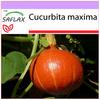
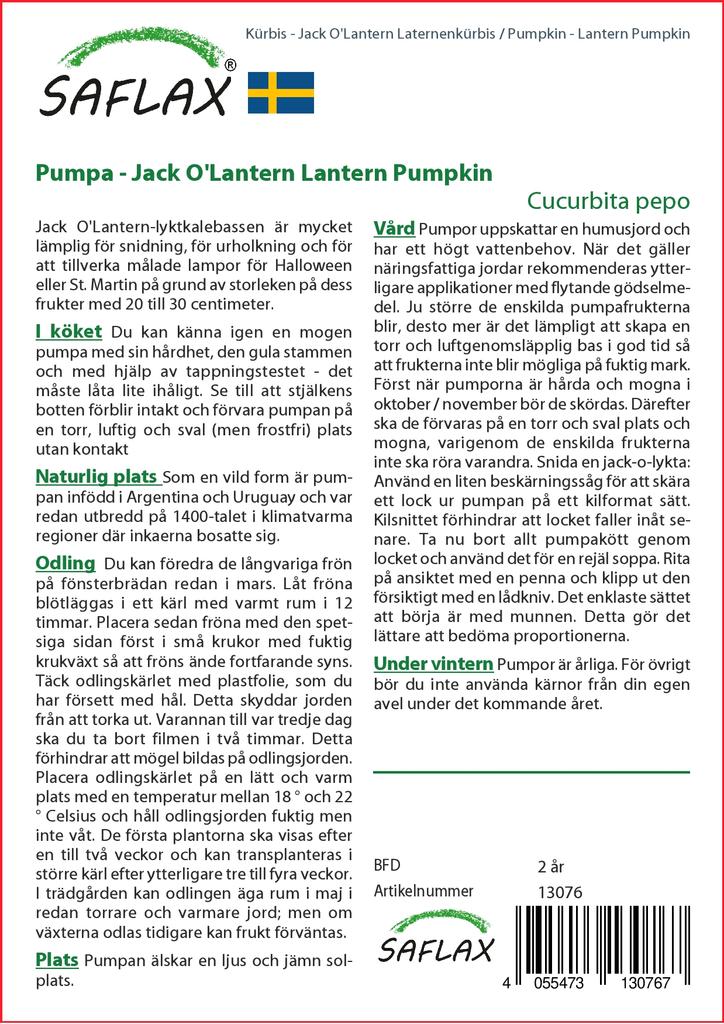
The Jack O'Lantern Lantern Pumpkin is, due to the size of its fruit, with 20 to 30 centimeters very well suited for carving, hollowing and making painted lamps for Halloween or St. Martin.
Natural Location:
As a wild form, the pumpkin is native to Argentina and Uruguay and was already widespread in the 15th century in climatically warm areas where Incas settled.
Cultivation:
The long lasting seeds can already be precultivated on the windowsill from March. Let the seeds initially for 12 hours in a container with room-warm water. Then place the seeds with the pointed side first in small pots with moist soil so that the end of the seed is still easily visible. Cover the container with cling film and make holes in it. This protects the soil from drying out. Every two to three days you should remove the foil for 2 hours. This prevents mould from forming on the growing soil. Place the container in a light and warm place with a temperature between 18° and 22° Celsius and keep the soil moist, but not wet. The first seedlings should appear after one to two weeks and can be transplanted into larger containers after another three to four weeks. In the garden, cultivation can be done in May in already drier and warmer soil; however, fruits can be expected earlier if the plants are grown earlier.
Place:
The pumpkin loves a bright and even full sunny location.
Care:
Pumpkins appreciate humusy soil and have a high water requirement. In nutrient-poor soils, additional application of liquid fertilizer is recommended. The larger the individual pumpkin fruits become, the more it is also recommended to create a dry and air-permeable base in time to prevent the fruits from going mouldy on damp soil. Only when the pumpkins are hard and ripe in October / November should they be harvested. Afterwards they should be stored in a dry and cool place and ripen, whereby the individual fruits should not touch each other. Carve a pumpkin lantern: Cut with a small saw wedge-shaped inwards a lid from the pumpkin. The wedge-shaped cut prevents the lid from falling inwards later. Now remove all pumpkin flesh through the lid and use it for a hearty soup. Paint the face with a pencil and cut it out carefully with a carpet knife. It is easiest to start with the mouth. This way you can better estimate the proportions.
During the winter:
Pumpkins are annual. You should not use seeds from your own breeding in the coming year.
Picture credits:
- © © Luke - Public Domain - http://creativecommons.org/licenses/publicdomain/
- © Frank Laue - © Saflax - http://www.saflax.de/copyright
- © Frank Laue - © Saflax - http://www.saflax.de/copyright
- © - -
- © - -
- © - -
- © - -
- © - -
- © - -






 No-delivery refund