Worth knowing:
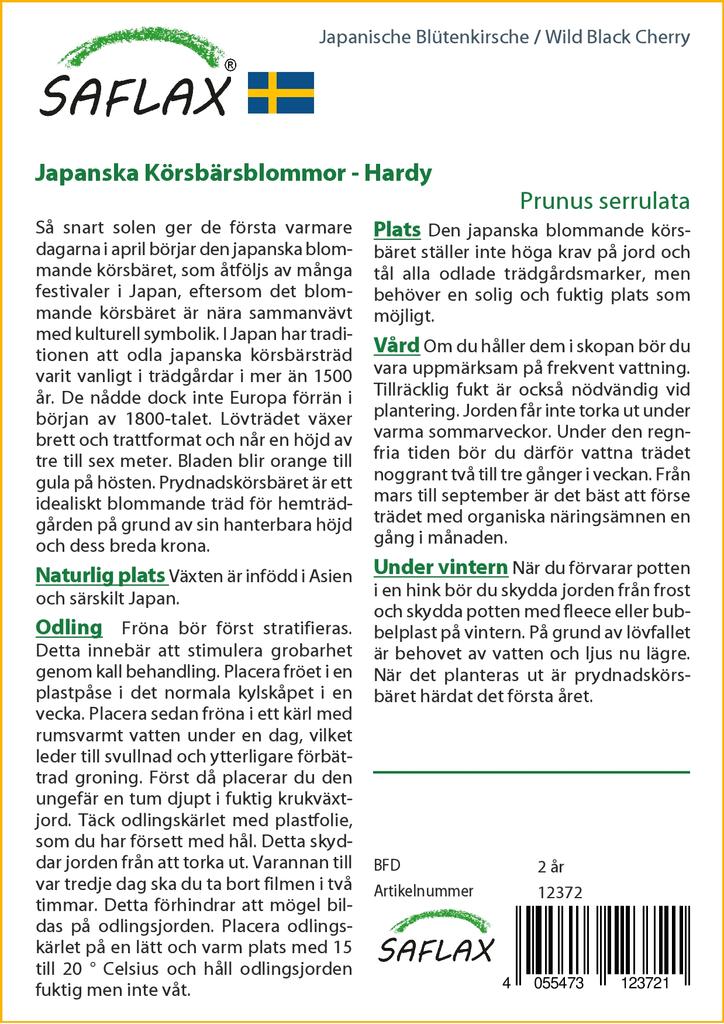
As soon as the sun in April gives us the first warm days, the sumptuous flowering of the Wild Black Cherry begins. In Japan that gives reason for numerous celebrations since the Wild Black Cherry is an important part of the culture. The tradition of cultivating Japanese cherry trees in gardens, goes in Japan more than 1500 years back. The plant only spread to Europe since the beginning of the 19th century. The deciduous tree grows wide and funnel-shaped and can reach heights between three and six meters. During autumn the leaves take on an orange or yellow colour. With its manageable height and the wide crown, the Wild Black Cherry is an ideal flowering tree for your garden.
Natural Location:
The Wild Black Cherry has its home in Asia and especially in Japan.
Cultivation:
Seed propagation indoors is possible throughout the year. It is advisable to stratify the seeds first, which means to stimulate and prepare the seed with a cold treatment. For that you have to keep it sealed in a plastic bag in the regular refrigerator for about one week. After that, place the seeds for another day in warm water for priming, so that the swelling further increases its germinability. Now you can plant the seeds about 1 cm deep in moist potting compost. Cover the seed container with clear film to prevent the earth from drying out, but don’t forget to make some holes in the clear film and take it every second or third day completely off for about 2 hours. That way you avoid mold formation on your potting compost. Place the seed container somewhere bright and warm with a temperature between 15°C and 20° Celsius and keep the earth moist, but not wet. Usually within four to ten weeks the first seedlings will come up.
Place:
The Wild Black Cherry can easily be cultivated in all types of good garden soil, but it needs a sunny and preferable also moist place.
Care:
While cultivating the tree in a tub, it should be watered frequently. Even when planted outdoors, a sufficient watering is necessary. During the hot summer you should water your tree two to three times a week penetratingly, to prevent the earth from drying out. From March untill September you also better give some organic nutrients once a month.
During the winter:
When kept in a tub it is necessary to protect the earth from frost by wrapping fleece or bubble wrap around the pot. The tree will need smaller amounts of water and light during the winter, because it casts the leaves. Outdoor plants will already be frost-resistant after one year.
Picture credits:
- © © Myrabella - CC-BY-SA-3.0 - http://creativecommons.org/licenses/by-sa/3.0
- © Frank Laue - © Saflax - http://www.saflax.de/copyright
- © Frank Laue - © Saflax - http://www.saflax.de/copyright
- © KENPEI s photo - CC-BY-SA-3.0 - http://creativecommons.org/licenses/by-sa/3.0
- © Kropsoq - CC-BY-SA-3.0 - http://creativecommons.org/licenses/by-sa/3.0
- © Roberta F. - CC-BY-SA-3.0 - http://creativecommons.org/licenses/by-sa/3.0
- © Liné1 - CC-BY-SA-3.0 - http://creativecommons.org/licenses/by-sa/3.0
- © Myrabella - CC-BY-SA-3.0 - http://creativecommons.org/licenses/by-sa/3.0
- © - -




 No-delivery refund