Worth knowing:
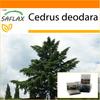
The Indian Cedar is with its unique growth form for everyone easy to make out. The evergreen conifer tree develops its main branches with hanging tips horizontally and grows this way almost more wide than high. Its blue-green or grey-blue coloured soft needle tussocks are mostly seated on the short sprouts and only randomly found on the longer shoots. The needles with 4 to 5 cm length are considered one of the longest of all cedar species. After blossoming in autumn, the Indian Cedar produces up to 8 cm long cones that neatly stand upright on the branches.
Natural Location:
The natural habitat of the Indian Cedar reaches from West Nepal until eastern Afghanistan, where it grows in heights between 1.000 and 3.000 meters above sea level.
Cultivation:
Seed propagation indoors is possible throughout the year. To increase the germinability, you should keep the seeds sealed in a plastic bag in the regular refrigerator for about a week. After that, plant the seeds about 1 cm deep into moist potting compost or sandy bonsai earth and cover the seed container with clear film to prevent the earth from drying out. Don’t forget to make some holes in the clear film and take it every second or third day completely off for about 2 hours. That way you avoid mold formation on your potting compost. Place the seed container somewhere bright and warm with a temperature around 20° Celsius and keep the earth moist, but not wet. The germination takes about four to ten weeks.
Place:
The Indian Cedar prefers to be kept in a full sunny spot.
Care:
Water the plant sufficiently and consistantly, but without waterlogging. From May until September you may give special fluid fertilizer for bonsai plants every three weeks.
During the winter:
The Indian Cedar is limited frost-hard until -10° Celsius, but for hibernation the plant is best be kept in a bright place with temperatures around 10° to 15° Celsius. However, the Indian Cedar has a remarkable ability to regenerate in case a strong winter left its mark on the plant.
Picture credits:
- © © Cliff - CC-BY-2.0 - http://creativecommons.org/licenses/by/2.0
- © Frank Laue - © Saflax - http://www.saflax.de/copyright
- © Frank Laue - © Saflax - http://www.saflax.de/copyright
- © Cliff - CC-BY-2.0 - http://creativecommons.org/licenses/by/2.0
- © - -
- © - -
- © - -
- © - -
- © - -








 No-delivery refund