Worth knowing:
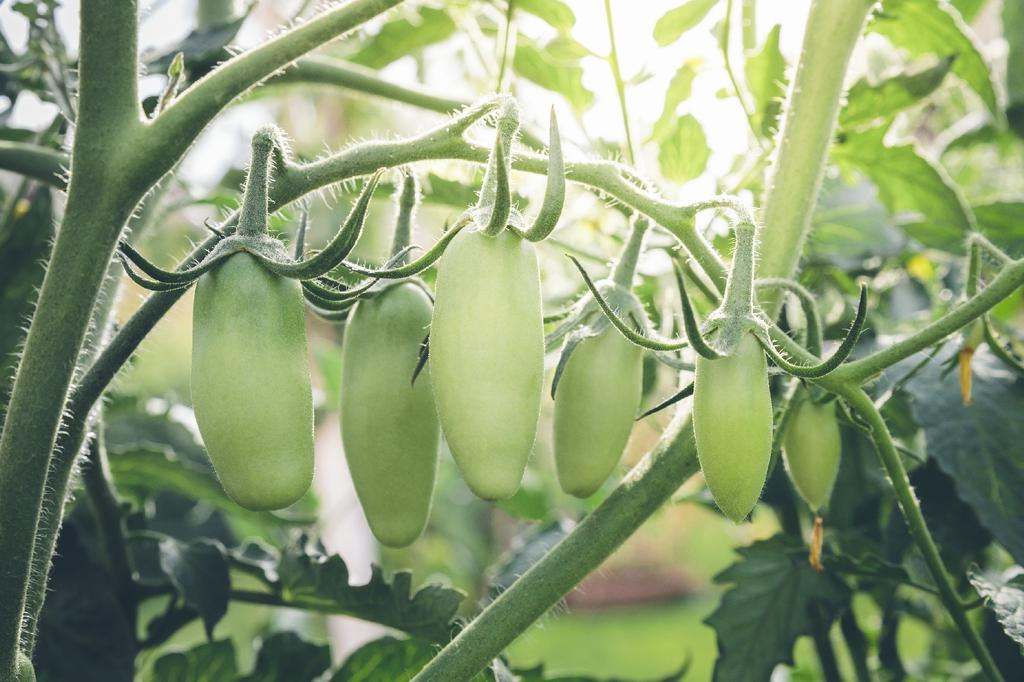
The traditional Italian variety San Marzano produces between 90 and 120 grams weighing, fleshy fruits that contain only a few seed kernels. It is especially suited for cooking and filling, as well as for sauces and purees. This medium-ripening, bottle-shaped stake tomato with its balanced acid-sugar ratio is quite rightly considered number one of the cooking varieties in Italian cuisine, and is really unmatched for preparing sauces. After it was almost forgotten, the Italian Slow Food movement managed to trigger the reproduction and re-cultivation of this bottle or plum tomato.
Natural Location:
Tomatoes originally came from South and Central America.
Cultivation:
You may start seed propagation in mid March at a bright and warm place indoors. Spread the flat seeds about 2 cm apart from each other onto moist coconut substrate or organic herb substrate and cover them only slightly with earth. Keep your potting compost moist, but not wet – preferably by using a water sprayer for moistening. Cover the seed container with clear film to prevent the earth from drying out. Don’t forget to make some holes in the clear film and take it every second or third day completely off for about 2 hours. That way you can avoid mold formation on your potting compost. Place the seed container somewhere bright and warm with a temperature between 20° and 24° Celsius. The first seedlings should come up after one or two weeks. Now, you can remove the cover and keep the sprouts in a somewhat cooler, but bright place without exposing them to the hot midday sun. As soon as the seedlings develop the second pair of leaves, you can prick out until the first pair of leaves, and plant the sprouts into small 10 cm pots with a bottom hole and filled with organic vegetable substrate. When they reach a height of approximately 10 cm, you need to support the plants with a small stick. In mid May and after the Ice Saints, the plants can be planted out at a sunny place in the garden with around 75 cm gaps between them, or you move them into tubs.
Place:
A sunny place that is sheltered from the rain and wind would be ideal for cultivation.
Care:
As the plants grow tall they will need strong supporting struts or tomato stakes. Water the plants evenly, but avoid water-logging. Pluck out the side-shoots between the stem and the base of the branches regularly. Since the rooting of the plants will develop strongly in the beginning, the visible sprouts grow rather slow initially. About 4 weeks and 8 weeks after planting out, you may provide the plant with some organic vegetable fertilizer.
During the winter:
Sow again the following year.
Picture credits:
- © Frank Laue - © Saflax - http://www.saflax.de/copyright
- © Frank Laue - © Saflax - http://www.saflax.de/copyright
- © Frank Laue - © Saflax - http://www.saflax.de/copyright
- © About © : Contact SAFLAX - - http://www.saflax.de/copyright
- © About © : Contact SAFLAX - - http://www.saflax.de/copyright
- © About © : Contact SAFLAX - - http://www.saflax.de/copyright
- © About © : Contact SAFLAX - - http://www.saflax.de/copyright
- © About © : Contact SAFLAX - - http://www.saflax.de/copyright
- © About © : Contact SAFLAX - - http://www.saflax.de/copyright










 No-delivery refund