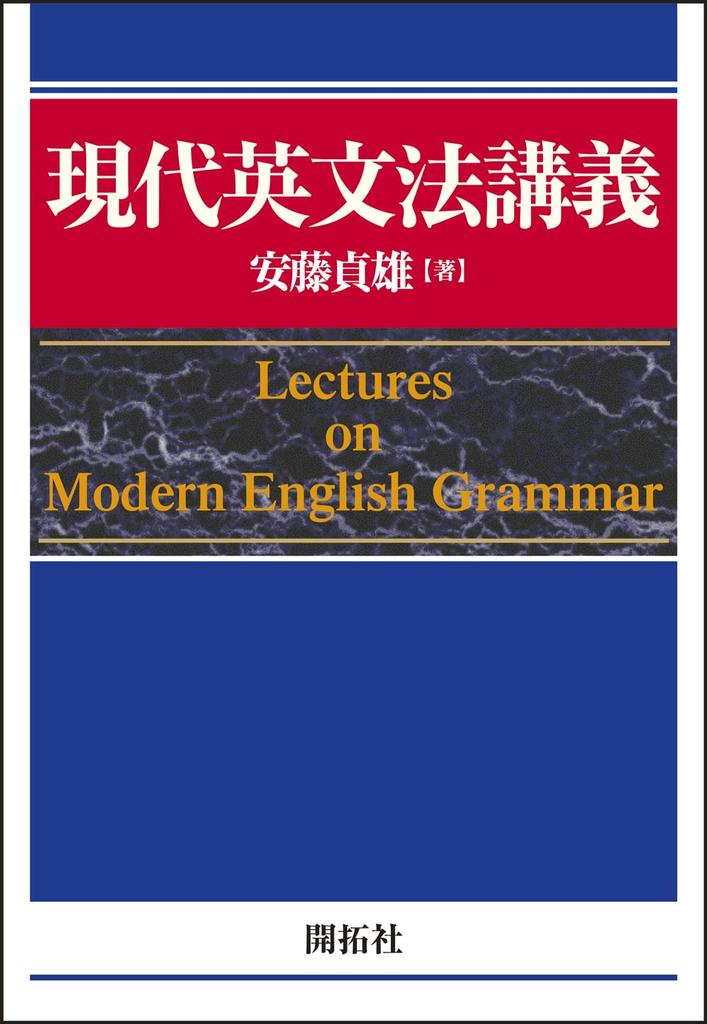
Lectures On Modern English Grammar


 No-delivery refundQuality guaranteeSecure logisticsPrivacy protection
Description
This is the author's life's work, a culmination of over half a century of English grammar research.
It is not only an academic book that organizes a wealth of examples based on the author's grammatical perspective, but also a reference grammar that can be kept close at hand and consulted whenever a question about English grammar arises. In doing so, the author has not only described the "how" of English grammatical phenomena, but has also sought to answer the "why" of them. The greatest feature of this book can be summed up in one word: "explanatory grammar."
■The cross-references are detailed, and the index, in particular, is detailed and easy to use, with the aim of answering any and all questions the reader may have about English grammar.
■Important topics (modal verbs, complement structures, etc.) are described in-depth and in-depth.
■ It clarifies regional differences such as "American," "British," and "Northern British," differences in English style such as "archaic," "formal," "informal," "elegant," irony, and nonsense, and registers of use such as law and commerce.
■ Noteworthy sections are provided throughout to address somewhat specialized or advanced topics, and the book also incorporates extensive insights unearthed in generative grammar and cognitive linguistics in a format that is easy for the general reader to understand.
■ Examples are taken from literary works wherever possible, and the number of examples is large. This is because it is in the realm of literature that the most creative uses of language are seen, and because I believe that, in a sense, the quality of the examples is what clarifies a grammar book.
■ Comparisons are made throughout with similar expressions in other languages, such as Japanese, German, and French. This is because I believe this should raise awareness of the universality of human language.
■ Historical explanations are also provided where necessary. Because English has a long history and old usage persists in modern English, there are many linguistic phenomena that can only be explained from a historical perspective.
7th Society of English Usage and Grammar Award Winner
l Table of Contents
Preface Legend
Chapter 1: Introduction 1.1. Sentences and Their Elements 1.2. Words, Phrases, and Clauses 1.3. Types of Sentences
Chapter 2: Sentence Patterns 2.1. What is a Sentence Pattern? 2.2. Basic Sentence Patterns 2.3. Derived Sentence Patterns
Chapter 3: Sentence Elements 3.1. Subject 3.2. Object 3.3. Complement 3.4. Quasi-Complement 3.5. Obligatory Adverbial Phrases 3.6. Sentence Elements 3.7. Semantic Roles of the Main Sentence Elements
Chapter 4: Tense and Aspect 4.0. Overview 4.1. Three Points of Time 4.2. Tense and Aspect/Aspect 4.3. Aspect of Lexical Verbs Characteristics
Chapter 5: Present Tense 5.0. Overview 5.1. Referring to the Present 5.2. Referring to the Past 5.3. Referring to the Future 5.4. Perfect Present Tense 5.5. Transtemporal Present 5.6. The Essential Meaning of the Present Tense
Chapter 6: Past Tense 6.0. Overview 6.1. Referring to the Past 6.2. Special Uses of the Past Tense 6.3. The Essential Meaning of the Past Tense
Chapter 7: Expressions Expressing Future Time 7.0. Overview 7.1. Expressions Expressing Future Time 7.2. Other Expressions 7.3. Comparison of Forms
Chapter 8: Progressive Tense 8.0. Overview 8.1. Characteristics of the Progressive Tense 8.2. Use of the Progressive Tense 8.3. Special Uses of the Progressive Tense
Chapter 9: Perfect Tense 9.0. Overview 9.1. Present Perfect Tense 9.2. Past Perfect Tense 9.3. Future Perfect Tense
Chapter 10: Perfect Progressive Tense 10.0. Overview 10.1. Present Perfect Progressive Tense 10.2. Past Perfect Progressive Tense 10.3. Future Perfect Progressive Tense
Chapter 11: Be, Have, Do 11.0. Overview 11.1. Use of Be, Have, and Do
Chapter 12: Interrogative Words 12.0. Overview 12.1. Interrogative Pronouns 12.2. Interrogative Adverbs 12.3. Indirect Questions
Chapter 13: Relative Clauses 13.0. Overview 13.1. Relative Pronouns 13.2. Free Relative Clauses 13.3. As, Than, But 13.4. Relative Adverbs
Chapter 14: Infinitives 14.0. Overview 14.1. Noun Use of the "To" Infinitive 14.2. Adjective Use of the "To" Infinitive 14.3. Adverbial Use of the "To" Infinitive 14.4. Verb Use of the "To" Infinitive 14.5. Use of the Bare Infinitive 14.6. Subjects of Infinitives 14.7. Other Uses of the Infinitive
Chapter 15: Participles 15.0. Overview 15.1. As Noun Modifiers 15.2. As Subject Complements 15.3. As Quasi-Subject Complements 15.4. As Predicates of Complementary Sentences 15.5. Participial Clauses
Chapter 16: Gerunds 16.0. Overview 16.1. Gerund Usage 16.2. Three Types of Gerunds 16.3. Subjects of Gerunds 16.4. Gerunds and the Perfect Infinitive 16.5. Gerunds 16.6. Gerunds and Infinitives 16.7. Idiomatic Expressions Containing Gerunds
Chapter 17: Modal Verbs 17.0. Overview 17.1. Meaning and Usage of Present Tense Forms 17.2. "Modal Verbs + Perfect Infinitive" 17.3. Meaning and Usage of Past Tense Forms 17.4. Summary 17. 5. "Past Tense Modal Verb + Perfect Infinitive" 17.6. Radical and Cognitive Uses
Chapter 18: Voice 18.1. Characteristics of the Passive Voice 18.2. Constraints on the Passive Voice 18.3. Get Passive Voice 18.4. Passive Voice in Various Constructions
Chapter 19: Predicates 19.0. Overview 19.1. Predicates in the Present 19.2. Predicates in the Past 19.3 . Predicate Past Perfect 19.4. Equivalents of "if" Clauses 19.5. Omission of Conditional and Consequential Clauses
Chapter 20: Nouns 20.0. Overview 20.1. Use of Noun Phrases 20.2. Types of Nouns 20.3. Gender of Nouns 20.4. Number of Nouns 20.5. Case in English
Chapter 21: Pronouns 21.0. Overview 21.1. Persons Personal Pronouns 21.2. Special Uses of Personal Pronouns 21.3. Use of the Personal Pronoun "it" 21.4. Direct and Retrograde Anaphora 21.5. Reflexive Pronouns 21.6. Demonstrative Pronouns
Chapter 22: Articles 22.0. Overview 22.1. Definite Articles 22.2. Indefinite Articles 22.3. Article Order 22.4. Article Omission and Repetition
Chapter 23: Adjectives 23.0. Overview 23.1. Characteristics of Adjectives 23.2. Use of Adjectives 23.3. Order of Adjectives 23.4. Semantic Subclassification of Adjectives
Chapter 24: Quantifiers 24.0. Overview 24.1. Characteristics of Quantifiers 24.2. Indefinite Quantifiers 24.3. Numerals 24.4. Reading Numbers
Chapter 2 Chapter 5: Adverbs 25.0. Overview 25.1. Classification of Adverbs 25.2. VP Adverbs 25.3. Sentence Adverbs 25.4. Hierarchy and Placement of Adverbs 25.5. Topical Adverbs 25.6. Adverbs to Watch Out For 25.7. Adverbs with Confusing Meanings and Usage 25.8. Hierarchy of Adverbial Clauses 25.9. Conjunctional Adverbs
Chapter 26: Comparative Constructions 26.0. Overview 26.1. Comparative Changes 26.2. Conditions for Comparison 26.3. Comparative Construction Structure 26.4. Aspects of Comparative Constructions 26.5. Pseudo-Comparisons 26.6. Comparative Expressions to Watch Out For 26.7. Phrases for Emphasizing Comparatives and Superlatives 26.8. Idiomatic Expressions Including Comparisons
Chapter 27: Conjunctions 27.1. Coordination and Subordination Position 27.2. Conjunctions 27.3. Correlative Conjunctions 27.4. Subordinating Conjunctions Introducing Noun Clauses 27.5. Subordinating Conjunctions Introducing Adverbial Clauses
Chapter 28: Prepositions 28.1. Types of Prepositions 28.2. Prepositional Structure and Function 28.3. Postpositional Positioning 28.4. Prepositional Ellipsis 28.5. Prepositions of Place 28.6. Time Prepositions 28.7. Other Prepositions
Chapter 29: Negation 29.0. Overview 29.1. Sentence Negation 29.2. Constituent Negation 29.3. Quantifiers and Negation 29.4. Other Issues in Negation
Chapter 30: Conditional Sentences 30.0. Overview 30.1. Aspects of Conditional Sentences 30.2. Other Conditional Sentences 30.3. Presupposed Clause Construction Structure
Chapter 31: Agreement 31.0. Overview 31.1. Subject and Predicate Verb 31.2. Determiners and Nouns 31.3. Other Number Agreement 31.4. Case Agreement 31.5. Gender Agreement 31.6. Aspect Agreement
Chapter 32: Tense Anaphora 32.1. Tense Anaphora 32.2. Principles of Tense Anaphora and Nonanaphora 32.3 Verbs A and B 32.4. Cases Without Tense Anaphora
Chapter 33: Direct and Indirect Speech 33.0. Overview 33.1. Direct Speech 33.2. Indirect Speech 33.3. Mixed Speech 33.4. Indirect Speech, Including Compound and Complex Sentences 33.5. Free Speech
Chapter 34: Substitutes and Ellipses 34.0. Overview 34.1. Substitutes 34.2. Omission
Chapter 35: Phrasal Verbs 35.0. Overview 35.1. Type 1: "Intransitive Verb + Adverb" 35.2. Type 2: "Intransitive Verb + Preposition" 35.3. Type 3: "Intransitive Verb + Adverb + Preposition" 35.4. Type 4: "Transitive Verb + Adverb" 35.5. Syntactic Distinction between Type 4 and Type 2 35.6. Type 5: "Verb + Object + Adverb" 35.7. Type 6: "Transitive Verb + Noun Phrase + Preposition" 35.8. Type 7: "Intransitive Verb + Prepositional Phrase + Prepositional Phrase" 35.9. Type 8: "Transitive Verb + Noun Phrase + Adverb + Preposition" 35.10. Other Types
Chapter 36: Information Structure 36.1. Information Structure of the Sentence 36.2. Unmarked Topics 36.3. Marked Topics 36.4. Demonstrative Sentences 36.5. Transference 36.6. Emphasis
Chapter 37: Complement Structures 37.0. Overview 37.1. Complements and Adjuncts 37.2. Noun Complement Structures 37.3. Adjective Complement Structures 37.4. Verb Complement Structures 37.5. Adverbial and Prepositional Complement Structures
Chapter 38: Movement of Elements 38.0. Overview 38.1. Head Shift 38.2. NP Shift 38.3. Wh Shift 38.4. Rightward Shift
Chapter 39: Sentence Functions 39.1. Declarative Sentences 39.2. Yes/No Questions 39.3. Wh Shifts 39.4. Other Questions 39.5. Imperative Sentences 39.6. Exclamatory Sentences 39.7. Short Sentences
References Index