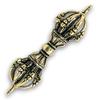
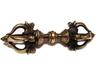
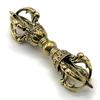
Sankosho (Vajra) is a metal pestle-shaped Buddhist implement used in temples and a ritual implement of esoteric Buddhism. Early forms of esoteric Buddhism were practiced in Japan during the Nara period, before Kukai formally introduced esoteric Buddhism. This item is called a sankosho (three-pronged vajra) after the number of prongs on the vajra (final vajra) from that period. A vajra is a pestle-shaped weapon with sharp blades on both ends of the handle, shaped like a thunderbolt. It comes in three shapes: a single-pronged vajra, a three-pronged vajra, and a five-pronged vajra. We'll introduce the sankosho (three-pronged vajra), which is used to exorcise immediate dangers.
"History: The trident (vajra) is a ritual implement used since ancient times in Tibet and India for rituals, prayer, meditation, purification, and warding off evil. It was originally owned by Indra, the god of thunder, but later in Buddhism it was believed that a deity (Vajra) who wielded this weapon always accompanied the Buddha like a shadow, protecting him. The vajra as a ritual implement in esoteric Buddhism was adopted as a symbol of the enlightened wisdom that destroys worldly desires, as this weapon is strong and can destroy anything. The trident (vajra) that was introduced to Japan was the oldest form of vajra, and it is said to have been received by Kobo Daishi (Kukai) from his teacher and thrown when choosing a place to spread esoteric Buddhism, becoming the ritual implement that led Kobo Daishi (Kukai) to Mount Koya.
"Anecdote: In Indian mythology, Vajra refers to the thunderbolt sent down by Indra (Taishakuten). When Kobo Daishi, also known as Kukai, studied in Tang China as a Japanese envoy and was on the beach in Mingzhou before returning to Japan after receiving all the teachings of Esoteric Buddhism, he threw a trident towards the east, praying, 'Please show me a suitable place to spread Esoteric Buddhism in Japan,' and the trident flew off towards Japan on a purple cloud - this is the vajra. Its shape is infinity, the same as the circulation of a torus. Its double spiral shape is activated by the frequency of the user, and it is said to release upward spiral energy. In other words, the trident has been used because it is believed that by matching its frequency with the user's, it can ward off all difficulties around them and provide upward energy and guidance towards bliss.
[How to use] It has the power to destroy evil and is used to ward off difficulties and worldly desires, and simply having it close by is said to ward off misfortune and disaster. The vajra is often depicted in old Japanese picture scrolls, and in most cases it is held in the hand to align with one's own vibrations. It can be carried in a bag as a talisman, or placed in a place of concern, such as an altar at home, the entrance, the living room, the bedroom, or on a desk at work. Use it as you like, whether it's portable or permanent.
A weapon from Indian mythology for home safety, road safety, fulfillment of wishes, physical and mental health, prayers for passing exams, prayers for safe childbirth, elimination of misfortune, elimination of disasters, warding off epidemics, prosperous business, welcoming many customers, business success, prosperity for the company, improved performance, career advancement, bountiful harvests, prayers for a good catch, fulfillment of wishes, elimination of evil, fulfillment of wishes, academic success, successful employment, prayers for safe childbirth, maternal and child health, steady growth, prayers for conception, fertility, victory in competitions, good fortune from laughter, protection from misfortune for new homes, and increased financial luck. This beautifully shaped amulet will shatter demons and drive away worldly desires. Keep it close to you. Material: Alloy. Length: approx. 15cm, width: 4.3cm, thickness: 1.6cm, weight: approx. 300g
![Sankosho, Three-pronged Vajra, Vajra, Esoteric Buddhism, Ritual Implement, Amulet, Antique Art, Perfect for Passing Exams, Gift [Item]](https://img.joomcdn.net/b77f934e5320cd5b15357e9f535996143bd68cd9_721_1024.jpeg)
![Sankosho, Three-pronged Vajra, Vajra, Esoteric Buddhism, Ritual Implement, Amulet, Antique Art, Perfect for Passing Exams, Gift [Item]](https://img.joomcdn.net/348264e658fff8d1697d21dea9585d0884a2e296_1024_1024.jpeg)
![Sankosho, Three-pronged Vajra, Vajra, Esoteric Buddhism, Ritual Implement, Amulet, Antique Art, Perfect for Passing Exams, Gift [Item]](https://img.joomcdn.net/ca47019d951fd3e70119d24031380a85254b8b87_768_1024.jpeg)
![Sankosho, Three-pronged Vajra, Vajra, Esoteric Buddhism, Ritual Implement, Amulet, Antique Art, Perfect for Passing Exams, Gift [Item]](https://img.joomcdn.net/38f9e1cf929c6b95c8e1dd20fed1b4f6fe02483d_768_1024.jpeg)
![Sankosho, Three-pronged Vajra, Vajra, Esoteric Buddhism, Ritual Implement, Amulet, Antique Art, Perfect for Passing Exams, Gift [Item]](https://img.joomcdn.net/26706e0428f432951d82fb9595ecbfa4eb1b0809_768_1024.jpeg)
![Sankosho, Three-pronged Vajra, Vajra, Esoteric Buddhism, Ritual Implement, Amulet, Antique Art, Perfect for Passing Exams, Gift [Item]](https://img.joomcdn.net/d343bc99c3e5652342aa307316fcfc7905c48525_original.jpeg)
![Sankosho, Three-pronged Vajra, Vajra, Esoteric Buddhism, Ritual Implement, Amulet, Antique Art, Perfect for Passing Exams, Gift [Item]](https://img.joomcdn.net/26ba54730bf0bf28788b231908086040a45ba044_767_1024.jpeg)
![Sankosho, Three-pronged Vajra, Vajra, Esoteric Buddhism, Ritual Implement, Amulet, Antique Art, Perfect for Passing Exams, Gift [Item]](https://img.joomcdn.net/a472d6cf3e4d9cc026e61d46b2ab2b404f46d931_767_1024.jpeg)
![Sankosho, Three-pronged Vajra, Vajra, Esoteric Buddhism, Ritual Implement, Amulet, Antique Art, Perfect for Passing Exams, Gift [Item]](https://img.joomcdn.net/8f66d746d87a1b2e53770d6cb130f6ac53555ccf_768_1024.jpeg)


![Sankosho Three-pronged Vajra, Vajra, Esoteric Buddhist Ritual Implement, Amulet, Antique Art, Perfect for Passing Exams, Gift [Parallel Import]](https://img.joomcdn.net/b77f934e5320cd5b15357e9f535996143bd68cd9_70_100.jpeg)
![Sankosho, Three-pronged Vajra, Vajra, Buddhist Meditation Bell, Self-Defense, Sacred Item, Purification, Protection from Misfortune, Orin [Item]](https://img.joomcdn.net/8fa12465c66d2fd9aa2908ff52d5eb6dbdb23614_70_100.jpeg)


![Alloy Vajra Trident, 15cm Long, Shingon Buddhist Ritual Implement, Amulet, Protection from Misfortune and Disaster [Parallel Import]](https://img.joomcdn.net/552cc64c37b6f90e1d213eea8ef5e8f5e01d3631_100_100.jpeg)
![Kurita's Special Buddhist Statue [Buddhist Implement] Miyako Goko Vajra 16cm Made of Hinoki Wood, Carved Buddhist Altar Item 2790](https://img.joomcdn.net/80cf7bc35c670da622b77c69b75ee8b1fe8c1d40_100_100.jpeg)