[Important Note - For Overseas Customers]
Thank you for purchasing this product. Please read the following important notes carefully before using this product overseas.
1. Legislation and safety standards
This product complies with Japanese safety standards. Please check compatibility with local regulations and safety standards before use in your country.
Certain product categories (electronics, cosmetics, food, etc.) may require certification from the importing country.
2. About electrical products
[Voltage compatible]
When using electrical appliances, please note that they are designed according to Japanese voltage specifications (90-110V), so using them at a different voltage may cause malfunctions.
[Plug type]
Our products use the Japanese plug type (A type or B type).
Please use a conversion adapter if necessary.
[Important notes regarding transformers and adapters]
A transformer adjusts the voltage to suit the requirements of the equipment.
Conversion adapters only change the shape of the plug and do not adjust the voltage.
Using only the conversion adapter without a transformer may damage the product.
[About responsibility]
We are not responsible for any failure or damage caused by improper usage, such as operating the product without a transformer.
3. Language and manual
Product instructions and displays may only be in Japanese.
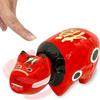
[Akabeko, a local toy from the Aizu region of Fukushima Prefecture] Akabeko is a folk craft representative of Fukushima Prefecture. It is a papier-mâché doll made of a cow with a red base and painted with black spots and white borders. Akabeko's neck is also designed to move, and when you touch it, the neck sways back and forth, making it an adorable folk craft.
[A lucky charm to ward off evil and disease] In the Tohoku region, especially in the Aizu dialect, "cow" is called "beko." In the past, it was called "evil-warding cow" or "lucky cow," and was loved by people as a lucky charm to ward off evil and disease.
[Rare production in Fukushima Prefecture] There were once dozens of manufacturing factories, but now only a few remain, and each toy is lovingly crafted by artisans. Almost all of the painting is done by hand. Only a limited number can be produced per day, making this a rare, handmade local toy.
[The History of Akabeko] There are various theories about the origins of Akabeko, but it dates back approximately 400 years. At the time, Gamo Ujisato, the lord of Aizu, promoted a policy to encourage side jobs to protect his samurai who were struggling to make ends meet due to lack of work. As part of this, he invited craftsmen from Kyoto to teach the samurai how to make papier-mâché dolls, and had them create papier-mâché Beko dolls. This is said to be the prototype of the local toy "Akabeko."
[Details] Made in Japan. Size: Approx. W140mm x D61mm x H80mm. Weight: Approx. 57g.
![In Rare Akabeko Good Luck Protection from Evil and Handmade Folk Craft Made In Fukushima Prefecture [Made Japan, Production] Cow, Cow, Disease,](https://img.joomcdn.net/f1b493dcd1485ff7347a7f34c0f1acef84429b03_1024_1024.jpeg)
![In Rare Akabeko Good Luck Protection from Evil and Handmade Folk Craft Made In Fukushima Prefecture [Made Japan, Production] Cow, Cow, Disease,](https://img.joomcdn.net/1e364f8de00c0aba4baae49322e1b50127d02111_1024_1024.jpeg)
![In Rare Akabeko Good Luck Protection from Evil and Handmade Folk Craft Made In Fukushima Prefecture [Made Japan, Production] Cow, Cow, Disease,](https://img.joomcdn.net/5b6a342660aa37f7464f5d9ed3b0798e8c7bc7eb_1024_1024.jpeg)
![In Rare Akabeko Good Luck Protection from Evil and Handmade Folk Craft Made In Fukushima Prefecture [Made Japan, Production] Cow, Cow, Disease,](https://img.joomcdn.net/dac464578baeac8d192c9be62d8aa5aeeaf981ee_1024_1024.jpeg)
![In Rare Akabeko Good Luck Protection from Evil and Handmade Folk Craft Made In Fukushima Prefecture [Made Japan, Production] Cow, Cow, Disease,](https://img.joomcdn.net/1c99e4eaebca4a1d98c078543ea746a922d53606_1024_1024.jpeg)
![In Rare Akabeko Good Luck Protection from Evil and Handmade Folk Craft Made In Fukushima Prefecture [Made Japan, Production] Cow, Cow, Disease,](https://img.joomcdn.net/54d429d83ff2bccd2fe90f3aa2ff607ac3a71c6f_1024_1024.jpeg)
![In Rare Akabeko Good Luck Protection from Evil and Handmade Folk Craft Made In Fukushima Prefecture [Made Japan, Production] Cow, Cow, Disease,](https://img.joomcdn.net/adf6e9babf1fcba0aefe496fa00e20c22ba58da6_1024_1024.jpeg)



![In Rare Akabeko Good Luck Protection from Evil and Handmade Folk Craft Made In Fukushima Prefecture [Made Japan, Production] Cow, Cow, Disease,](https://img.joomcdn.net/f1b493dcd1485ff7347a7f34c0f1acef84429b03_100_100.jpeg)

![Yakushigama Nishikisa Inviting Good Luck Dragon Fuku Lucky Purse Zodiac 2024 Tatsu New Year Ornament Interior Lucky Charms (yakushigama) [92]](https://img.joomcdn.net/f105c473cf6b899e525d3b7b07d233c209c47321_99_100.jpeg)

![Yakushigama Nishikisai Good Luck and Longevity Zodiac Clay Horse Zodiac New Year Lucky Charm (Yakushigama) Bell, [137-Horse], Ornament,](https://img.joomcdn.net/3e870f4d1a1d8f93f80d36dc72f99ac347588956_100_100.jpeg)
![Prayer Takasaki Daruma In Size Approximately 15cm Pray for Academic Achievement of Great Exam Pencil Takasaki Exam Victory [Shrine Pre-Prayed] Doll,](https://img.joomcdn.net/5c400cc4b78beea73fa26727c23f6af5029f2571_100_100.jpeg)



![Yakushigama Dyed Nishiki Lucky Dragon Seiryu Small Zodiac 2024 Tatsu New Year Ornament Interior Lucky Charm (Yakushigama) [88]](https://img.joomcdn.net/3c15879a57815505005fdb8138994ffcc20affb9_100_87.jpeg)