[Hakugado's "Famous Paintings Story Series"]
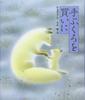
The "Famous Paintings Story Series" was born from the desire to create an environment where children could easily experience authentic art.
This picture book collection features large, vibrant images, and traces the lives of artists through easy-to-understand text alongside famous paintings. Since its first publication in 1992, it has been enjoyed by many families as an "art experience that can be enjoyed at home." Child education experts have also praised it, saying, "It's important for children to know the real thing. Exposing children to great art from an early age will help develop their sensibilities." Adults can also enjoy it as an introductory art book.
It has been selected by the Japan Library Association/National Council of School Libraries and is recommended for use in school textbooks.
Series Introduction Page: https://www.hakugado.co.jp
Series Introduction Blog: https://www.hakugado.co.jp/%e3%83%96%e3%83%ad%e3%82%b0
[Recommendation from Takashi Yanase]
I loved art as a child, so I grew up looking at the complete art collections in my father's study. However, they were all for adults, so I couldn't understand the explanatory text. I wanted to know more about the artist's personality. I wanted to know what kind of person created this painting, but the technical details were difficult to understand. This "Story Masterpiece Series" has large prints and vivid images, making it interesting enough for adults as well as children to read, and I think it triples the fun and excitement of looking at paintings.
[Recommendation from Poet Machi Tawara]
As the host of "Sunday Art Museum," I'm reminded of how many painters have led dramatic lives. I realized that knowing the artist's life is crucial to appreciating a painting. Learning about an artist's life deepens your appreciation of their work. In other words, it's something you can understand with your heart. I believe the "Famous Paintings" series is a book that connects you to paintings with your heart. It's truly wonderful to be able to encounter masterpieces in this way.
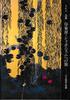
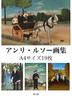
- Volume 4, "Henri Rousseau and Chagall" (B4 format, 64 full-color pages, 33 illustrations)
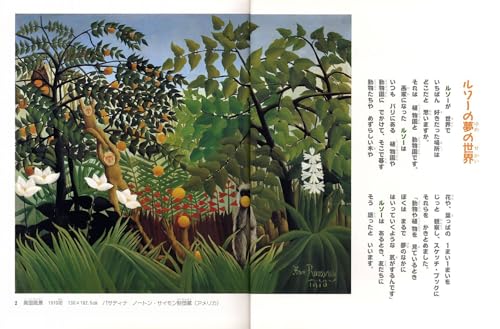
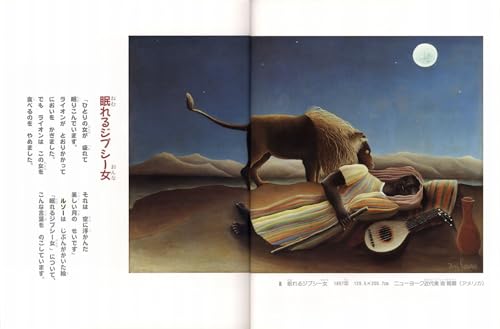
Henri Rousseau created fantastical paintings, including "The Dream," "Carnival Evening," "The Sleeping Gypsy," and "The Snake Charmer," based on sketches from zoos and botanical gardens.
Even as Chagall was embroiled in World War II, he continued to paint his beloved Russian countryside and his beloved Bella. This book traces the lives of these two artists while allowing you to appreciate their beautiful and fantastical paintings.
(Henri Rousseau)
Rousseau began painting seriously after turning 40, but people found it difficult to understand his works. Some people burst out in laughter, saying, "What a terrible painting! It's so funny I could cry!" For example, the size of Rousseau's figure in "Self-Portrait in a Landscape" defies perspective. His feet appear to be floating in the air. These works, which ignore the reality of the landscape, were the subject of ridicule. Nevertheless, Rousseau's work attracted many people, including the young genius painter Pablo Picasso. Always seeking new forms of expression, Picasso likely saw new artistic possibilities in Rousseau. After his death, he was highly praised by surrealist painters and had a profound influence on them.
Please start by appreciating Rousseau's work in this book. You will be amazed by his bold originality and vivid use of color.
(Marc Chagall)
Chagall, who continued to paint many magnificent paintings until his death at the age of 97, was born into a poor family in a small town in a remote corner of Russia.
Chagall used his wife, Bella, as a model to create one dreamlike painting after another. Bella is depicted floating in the air in "The Birthday." He must have been overjoyed that she had bought him a bouquet of flowers.
As a Jew, Chagall experienced two world wars, and lost his beloved Bella in America where he fled the ravages of war. Chagall's works, which show the strength of his spirit and the depth of his love, convey the artist's continued painting despite his many sorrows.



 No-delivery refund