Worth knowing:
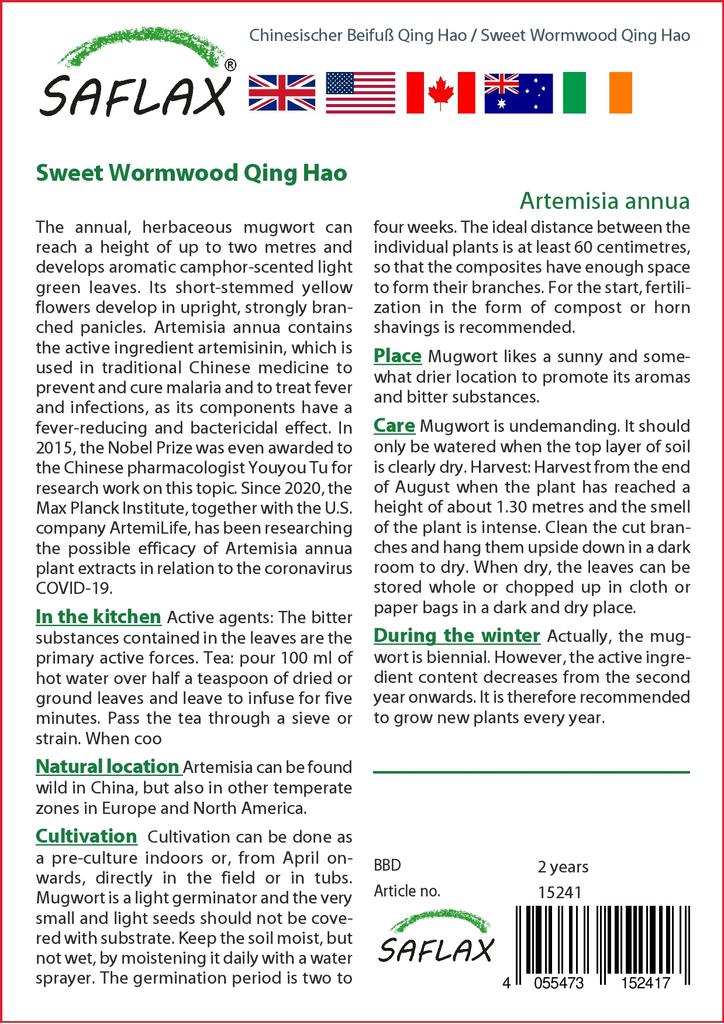
The annual, herbaceous mugwort can reach a height of up to two metres and develops aromatic camphor-scented light green leaves. Its short-stemmed yellow flowers develop in upright, strongly branched panicles. Artemisia annua contains the active ingredient artemisinin, which is used in traditional Chinese medicine to prevent and cure malaria and to treat fever and infections, as its components have a fever-reducing and bactericidal effect. In 2015, the Nobel Prize was even awarded to the Chinese pharmacologist Youyou Tu for research work on this topic.
Natural Location:
Artemisia can be found wild in China, but also in other temperate zones in Europe and North America.
Cultivation:
Cultivation can be done as a pre-culture indoors or, from April onwards, directly in the field or in tubs. Mugwort is a light germinator and the very small and light seeds should not be covered with substrate. Keep the soil moist, but not wet, by moistening it daily with a water sprayer. The germination period is two to four weeks. The ideal distance between the individual plants is at least 60 centimetres, so that the composites have enough space to form their branches. For the start, fertilization in the form of compost or horn shavings is recommended.
Place:
Mugwort likes a sunny and somewhat drier location to promote its aromas and bitter substances.
Care:
Mugwort is undemanding. It should only be watered when the top layer of soil is clearly dry. Harvest: Harvest from the end of August when the plant has reached a height of about 1.30 metres and the smell of the plant is intense. Clean the cut branches and hang them upside down in a dark room to dry. When dry, the leaves can be stored whole or chopped up in cloth or paper bags in a dark and dry place.
During the winter:
Actually, the mugwort is biennial. However, the active ingredient content decreases from the second year onwards. It is therefore recommended to grow new plants every year.
Picture credits:
- © © Can Stock Photo / rezkrr - -
- © Frank Laue - © Saflax - http://www.saflax.de/copyright
- © Frank Laue - © Saflax - http://www.saflax.de/copyright
- © Kristian Peters - CC-BY-SA-3.0 - http://creativecommons.org/licenses/by-sa/3.0
- © Stefan.lefnaer - CC-BY-SA-4.0 - http://creativecommons.org/licenses/by-sa/4.0
- © Raffi Kojian - CC-BY-SA-3.0 - http://creativecommons.org/licenses/by-sa/3.0
- © Kristian Peters - CC-BY-SA-3.0 - http://creativecommons.org/licenses/by-sa/3.0
- © - -
- © - -




 No-delivery refund